
Lower input power at the right duty
Compare complete system input kW at the same airflow and pressure, including motor, control and fan performance.
EC fans for AHUs in Malaysia
Same required airflow. Same static pressure. Lower input kW.
Upgrade energy efficiency while maintaining the air duty your AHU needs.
Explore Nicotra Gebhardt COPRA EC fans for AHU retrofits, new installations and fan arrays. True Aire helps match your fan system to the required airflow, pressure and operating profile.
AHU retrofit · New AHU specification · Fan arrays
01 / Why EC fans?
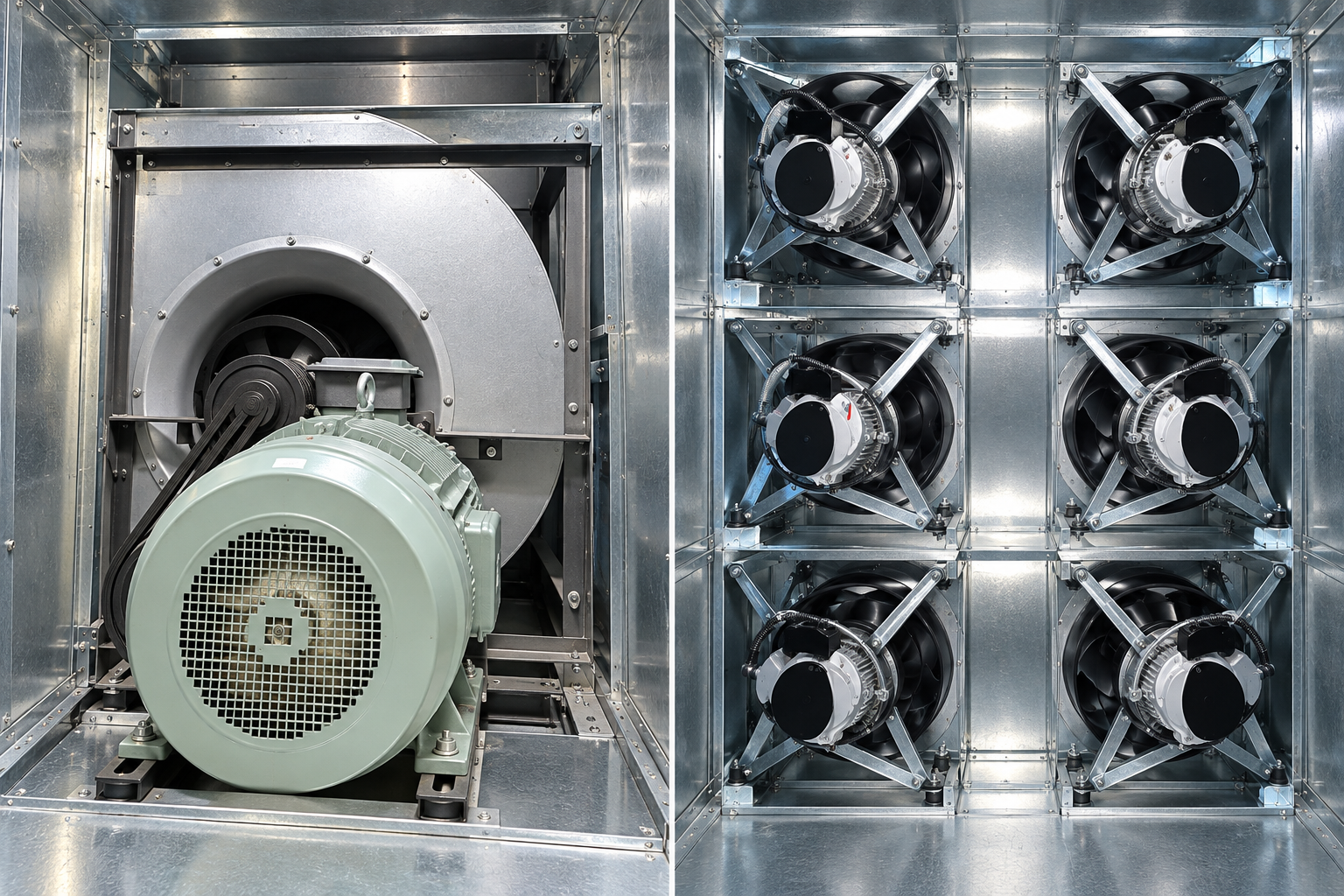
The upgrade target is lower electrical input while maintaining the required airflow and static pressure. Improve the impeller, motor, transmission and control as a complete system.
Compare complete system input kW at the same airflow and pressure, including motor, control and fan performance.
COPRA’s aerodynamic blade design may improve the selection against an older forward-curved fan. The actual gain depends on both fan curves and the duty point.
Remove belt slip, belt wear and pulley alignment from the proposed fan arrangement, along with their associated maintenance.
Select a fan model or multi-fan arrangement nearer the required airflow, pressure and efficient motor loading. When an existing fan is oversized, this can reduce avoidable part-load losses.
COPRA integrates speed control with its EC motor, removing the need for a separate external VSD for that function. Evaluate the combined fan, motor and control input at the required duty.
Technical basis: COPRA product details · US DOE fan system sourcebook · AMCA fan system efficiency
Energy efficiency upgrade / Case study
Upgrade from an AC blower to an EC fan array to reduce electrical input while maintaining the required airflow and static pressure. Compare the two systems across four operating points below.
| AC Blower | EC Fan Array | Savings | |||||||
|---|---|---|---|---|---|---|---|---|---|
| Hz | CMH | Pa | kW | Speed (%) | CMH | Pa | kW | kW | % |
| 49.5 | 68,876 | 932 | 38.65 | 100 | 69,000 | 932 | 25.56 | 13.09 | 33.9% |
| 38.3 | 58,127 | 596 | 22.88 | 73 | 58,140 | 596 | 13.86 | 9.02 | 39.4% |
| 28.4 | 44,328 | 310 | 10.89 | 53 | 44,328 | 310 | 5.76 | 5.13 | 47.1% |
| 23.6 | 37,800 | 210 | 7.68 | 44 | 37,800 | 210 | 3.42 | 4.26 | 55.5% |
CMH = airflow in m³/h. EC figures represent the complete six-fan array (6 × PA-C56-JV56-C0000). Savings = AC input − EC input; percentage savings are relative to AC input.
13.09 kW less electrical input.
Same 932 Pa static pressure, with airflow maintained at approximately 69,000 m³/h.
Results shown apply to these operating points. Savings for another AHU depend on the existing system, selected replacement and operating conditions.
AC blower vs EC fan / Upgrade options
A blade upgrade improves aerodynamics. Direct drive removes the belt transmission. A VSD adds speed control. An EC plug fan brings these improvements together in one selected system.
Indicative retrofit estimates. Savings depend on the existing equipment, selected solution and operating profile. Individual upgrade ranges are not additive; the complete system is assessed together. The 40% figure refers to fan energy, not total building electricity.
Speed control is one part of efficiency. The case study compares AC operation at 49.5, 38.3, 28.4 and 23.6 Hz with an EC array at comparable air duties. EC input power is lower at all four points.
03 / Targeted AHU retrofit
The retrofit replaces the blower assembly inside the fan section. Serviceable casing, filters and cooling coil stay in place, with mounting, electrical and control work adapted for the new fans.
After retrofit: side profiles of the EC fans and mounting wall, within the existing fan compartment.
Existing casing, cooling coil, filter sections and connected ductwork.
Fan assembly, motor and drive arrangement, with associated mounting, electrical connections and controls.
Typical AHU arrangement. Retained components and installation scope are confirmed during the site assessment.
04 / Meet Nicotra Gebhardt COPRA
Nicotra Gebhardt describes COPRA as an EC plenum fan with a short internal-rotor motor and backward-curved aluminium impeller. The range is suited to AHUs, retrofits and multi-fan arrangements.
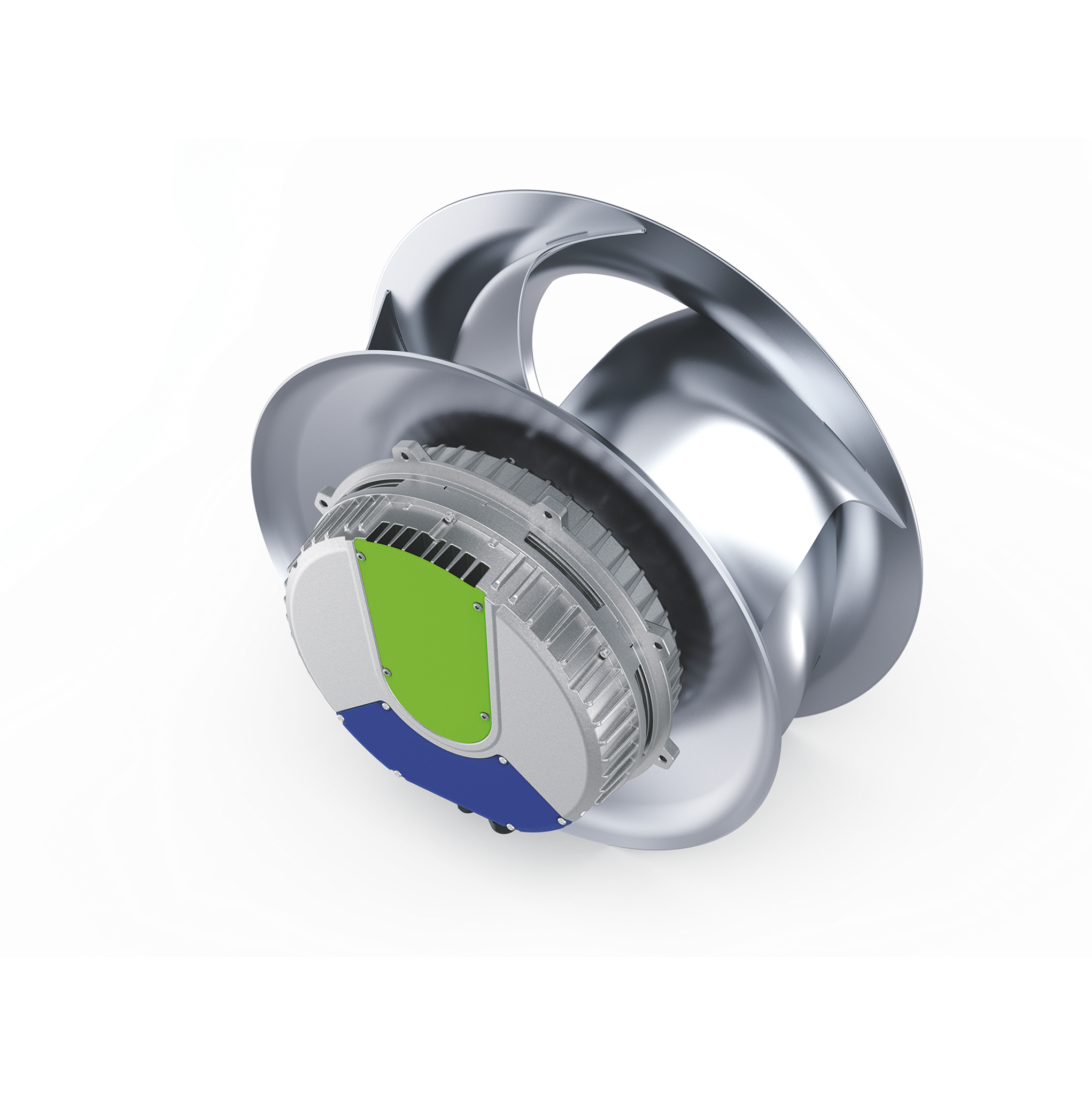 COPRA product image · Nicotra Gebhardt
Documented product evidence
The MyHIJAU Directory names True Aire as distributor for specific COPRA EC Plug Fan models. We show the model codes, listing numbers and expiry dates so procurement teams can check the record directly.
Model PA-C45-JM56-C0000 · MyHIJAU listing MyHP00418/25-001 · Valid to 3 September 2028.
Check the MyHIJAU record ↗05 / Project delivery
Follow the five stages of your AHU fan upgrade. Open each stage to explore the engineering, financial assessment and installation work.
Outcome: a documented baseline and an agreed air-duty requirement.
DESIGN vs CURRENT OPERATION
| Parameter | Original design | Current operation |
|---|---|---|
| Airflow | AHU schedule | Site measurement |
| Static pressure | Design duty | Site measurement |
| Power | Motor / fan data | Measured input kW |
| Control | Design sequence | Actual speed / mode |
Outcome: the required air duty maintained, with lower selected EC input kW demonstrated against the AC baseline.
AC vs EC / RUNNING POWER
13.09 kW lower · 33.9% reduction
At 932 Pa and approximately 69,000 m³/h
Example operating-point data from the case study. Each AC/EC pair has equal static pressure and approximately equal airflow. Lines connect the four comparison points; they are not manufacturer fan-performance curves. Final project selection includes the actual pressure–airflow curves and input-power data.
Outcome: an investment proposal with transparent assumptions.
EXPLORE SIMPLE PAYBACK
Illustrative assumptions, editable above. The 13.09 kW example assumes that power difference for all entered hours. A project proposal uses the actual duty schedule, quotation and maintenance costs. Simple payback excludes financing, discounting and tariff changes.
Outcome: the new fan system installed within the agreed AHU scope.
INSTALLATION SEQUENCE
Outcome: a commissioned system and a performance-verification record.
PERFORMANCE HANDOVER
| Check | Before | After |
|---|---|---|
| Airflow (CFM / CMH) | Baseline reading | Verified air delivery |
| Static pressure (Pa) | Baseline reading | Verified duty |
| Electrical input (kW) | Measured AC input | Measured EC input |
| BMS / controls | Existing sequence | Integration checked |
07 / Questions before you upgrade
An efficiency upgrade aims to reduce input power at the same required airflow and static pressure. The comparison above illustrates lower EC input at comparable air duty. Separately, speed control can adjust airflow when building demand changes.
No universal percentage applies. Compare the complete systems at equivalent airflow and pressure across the hours and loads you actually operate.
Often the fan section can be considered for retrofit, subject to the required air duty, available space, structural condition, power, controls and access. An engineering assessment determines suitability.
We have verified directory entries for particular COPRA EC Plug Fan model codes. Check the exact model quoted against the current directory record; do not assume that the listing covers the entire range.
An AHU schedule, existing fan model or nameplate, operating hours and photos are useful. Measured running power, airflow and pressure make the energy comparison stronger.
The installation window depends on access, mounting and fabrication, electrical work and commissioning. The proposal should identify the planned shutdown and the work needed before the AHU returns to service.
08 / Start your assessment
For an existing AHU, send the fan schedule, nameplate, operating hours and any measured running data. For new selections, start with airflow, pressure, quantity, available space and control requirements.
Use your preferred channel. No website form stores your project data.
Open WhatsApp to enquire ↗